When the queue moves faster than the menu
Takeaway service puts pressure on the menu itself. Prices shift, meal deals change, and the person behind the counter needs something that can be updated without taking the whole front of house out of action. Snap frames and menu boards solve that by holding printed inserts neatly, with the front cover lifting open so a new sheet can slide in within seconds. That suits lunch counters, bakery windows, deli service points and small restaurants that sell food to go.
In a compact outlet, the menu has to work from a distance and at close range. A4 suits a short list of add-ons or a single special board, while A3 gives more room for bundles, combos and larger item names. For takeaway spaces in Cape Town or inland centres, it helps to keep the main menu simple and let the smaller boards carry the rotating items.
The usual menu set for a takeaway counter
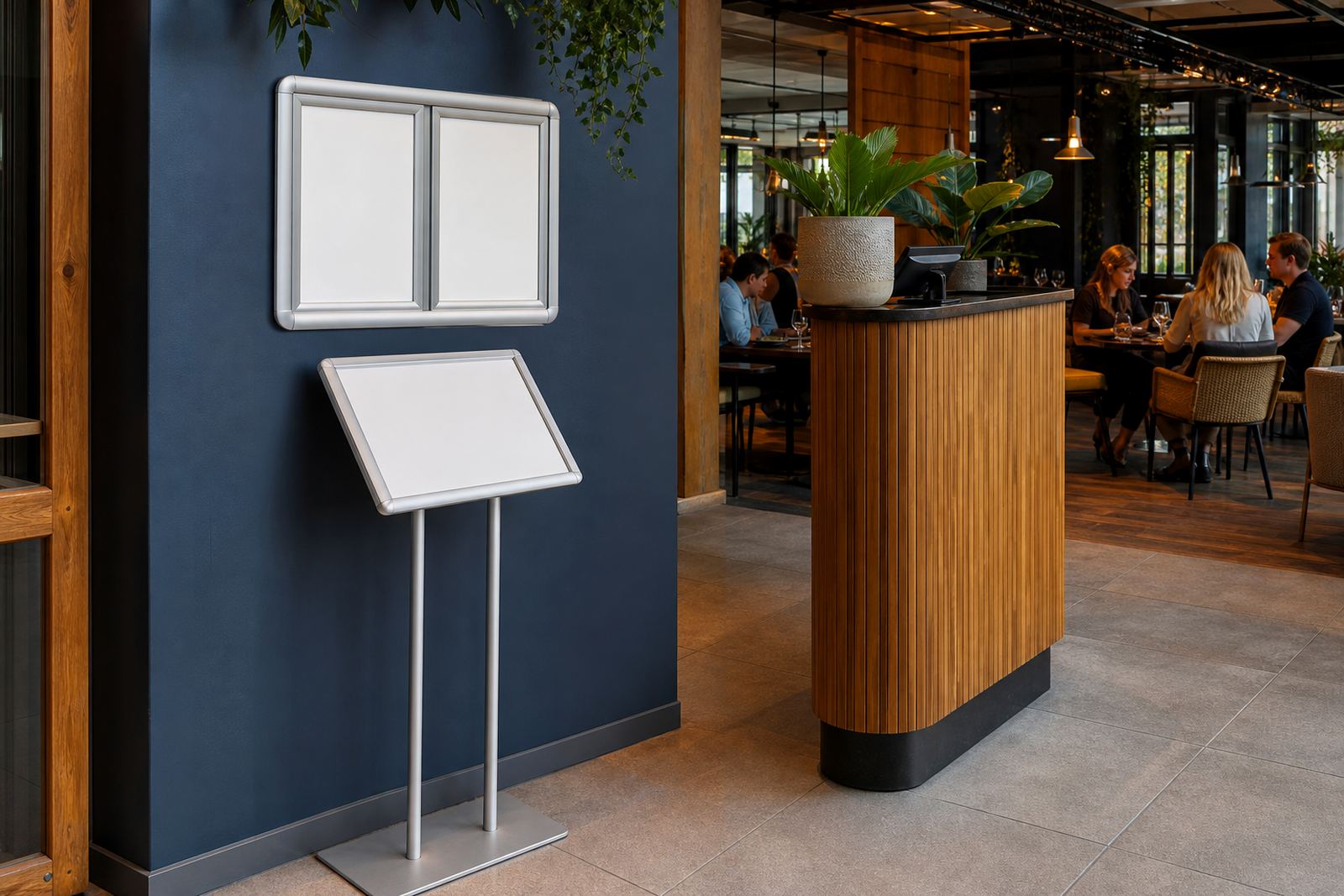
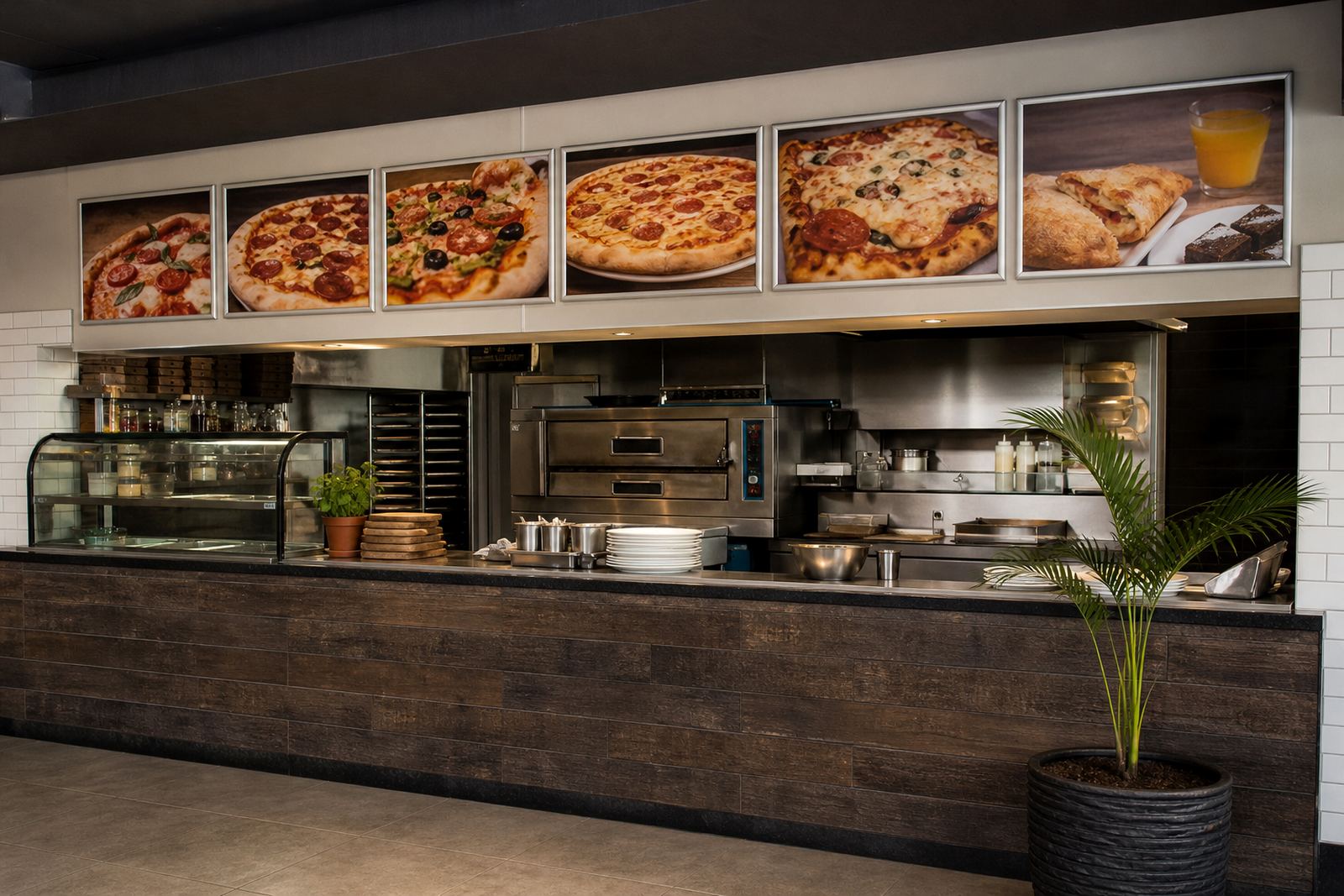
A practical setup often includes one main wall frame, a smaller counter-facing board and a stand near the queue or waiting point. Aluminium snap frames are common because they stay neat, open evenly and take repeated print changes without the edges fraying too quickly. Anti-glare covers help where sunlight hits a window display or bright downlights catch the surface.
- A3 snap frames for main menu boards and larger specials
- A4 frames for meal deals, add-ons and notices
- Wall mounting for the service side or waiting area
- Window mounting where passers-by need a quick read
- A-frame stands for foot traffic near the entrance or pavement edge
- Chalkboards for handwritten specials where the list changes often
We also handle laminated menu prints and poster insert printing for teams that want a cleaner finish than loose paper. Short run printing works well when a branch wants only a few copies for testing, then a wider rollout after the layout is settled.
Layout that keeps the order point calm
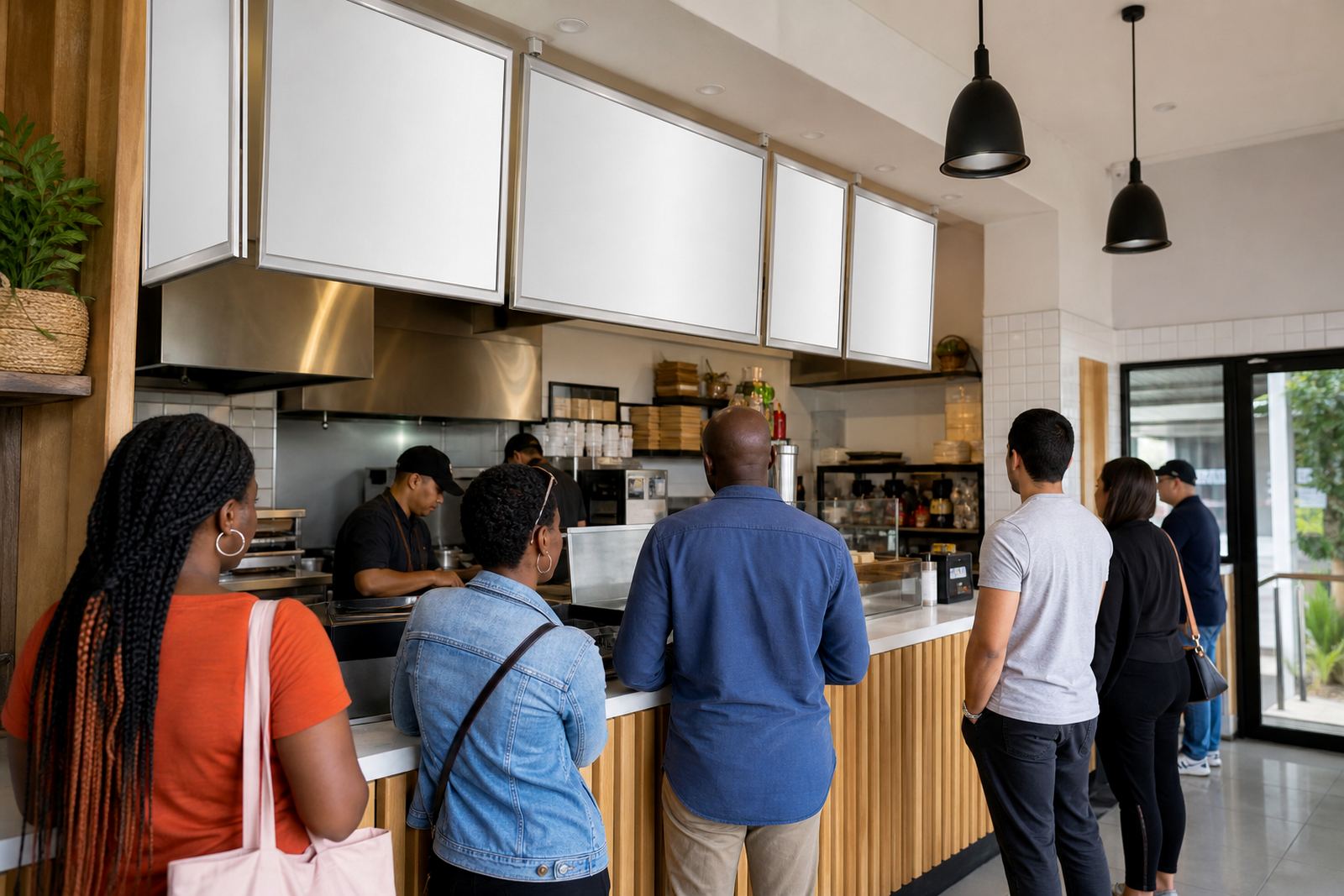
The best takeaway menus are arranged around the customer path, not just the wall space available. The first board should answer the main question fast: what is being sold, how much it costs, and where to place the order. Secondary boards can carry sides, drinks, extras and daily specials. That way the queue is not forced to read every item before deciding.
Height matters too. If the top line sits too high, shorter customers and seated guests struggle to read it. If it sits too low, taller people lean in and block the line. A wall frame above the counter usually works best when the centre of the menu sits around eye level, with a second board lower down for specials or smaller add-ons. In busy Durban food courts or a roadside stop near Paarl, that sort of spacing saves a lot of repeated pointing.
Colour matching matters where the menu already has an established look. Clear contrast between text and background matters more than fancy styling, especially when the board is seen through a window or across a deep queue.
Printing details that save rework
Menu printing for takeaways should be planned around the frame size first, then the text size and image placement. A3 prints carry more detail and suit wide menu categories. A4 works well for inserts that change often, or for one page specials placed beside the main list. When the wording changes, menu resizing and typesetting keep the design consistent so the board does not look patched together.
- Keep the most popular items near the top
- Use clear pricing blocks with enough space around each line
- Leave room for tax-inclusive prices if that is how the counter is run
- Avoid tiny scripts that disappear under glare or from across a queue
- Match the print finish to the room lighting and window position
Proofing is worth doing before a short run. A small spelling error on a takeaway board gets read many times in a day, and a missing price can slow staff down. With laminated inserts, the sheet stays flatter and wipes cleaner if the menu sits near food prep or a self-service drinks point.
Common mistakes on takeaway menus
One common mistake is trying to fit the whole menu onto one board. It looks tidy on paper, then the text gets too small and the queue slows down. Another is choosing a frame size after the artwork is finished, which usually means shrinking names or cutting off margins. A third issue is using a glossy cover in a strong light, so the board reflects more than it shows.
Another error is mixing too many styles in one outlet. If the main menu is printed, the specials board should not fight it with a different font, a different tone and no clear pricing structure. The customer should be able to glance once and know what belongs where. In takeaway spaces near Milnerton, Bellville or Gqeberha, where the foot traffic can change through the day, a consistent layout helps staff answer questions without stopping the line.
- Do not overcrowd a single A3 frame
- Do not place key prices where glare will hide them
- Do not use loose paper where frequent swaps are needed
- Do not leave specials without a fixed home on the wall
Budget bands for a takeaway setup
Budgets move with size, finish and how many boards the outlet needs. A single A4 snap frame for a simple notice or add-on can sit at the lower end of the range. Larger A3 wall boards, anti-glare covers and printed inserts lift the cost, and an A-frame stand adds more again because it serves as a freestanding sign. For a small takeaway counter, a basic setup might start around R600 to R1,500, depending on quantity and print content.
A more complete front-of-house set with several frames, printed inserts and one or two stands can fall between R2,000 and R6,500. If the order includes resizing, typesetting, proofing, short run printing and courier packaging, the total moves with the number of versions and delivery point. For branches in Cape Town, Stellenbosch, Johannesburg, Durban and Gqeberha, courier delivery is often the practical choice when the boards need to land at more than one site.
The best spend is usually on the main menu and the pieces that change most often. That is where the queue feels the difference.
Useful ways to brief the frame work
When a takeaway brief comes in, the useful details are usually plain ones: the frame size, the wall or window position, the number of menu pages, whether specials change weekly or daily, and whether the print needs lamination. It also helps to know if the board will sit in direct sun, under bright strips or near steam from the kitchen hatch. Those conditions affect the cover and the print finish.
We work from Paarden Eiland in Cape Town and handle print-ready templates, menu updates, print finishing and courier packaging for branches across South Africa. The team can keep the menu in one language or several, depending on the counter and the area it serves. For takeaways, the point is usually clarity first, then neat presentation, then a format staff can update without drama.
- Main frame size and count
- Wall, window or floor stand position
- Menu pages and special board content
- Laminate, poster insert or loose insert preference
- Delivery points for Cape Town, Stellenbosch, Johannesburg, Durban or Gqeberha
If the outlet needs help shaping the menu layout, our contact form is the best starting point for the details.