A workshop built around changing menus
The first work was shaped by a simple need on the floor. Menus change, prices shift, breakfast boards get updated, and specials do not wait for a full reprint cycle. SnapperFrame Menus grew around that daily pressure, with frames and menu boards that let a team swap inserts quickly and keep the front counter tidy.
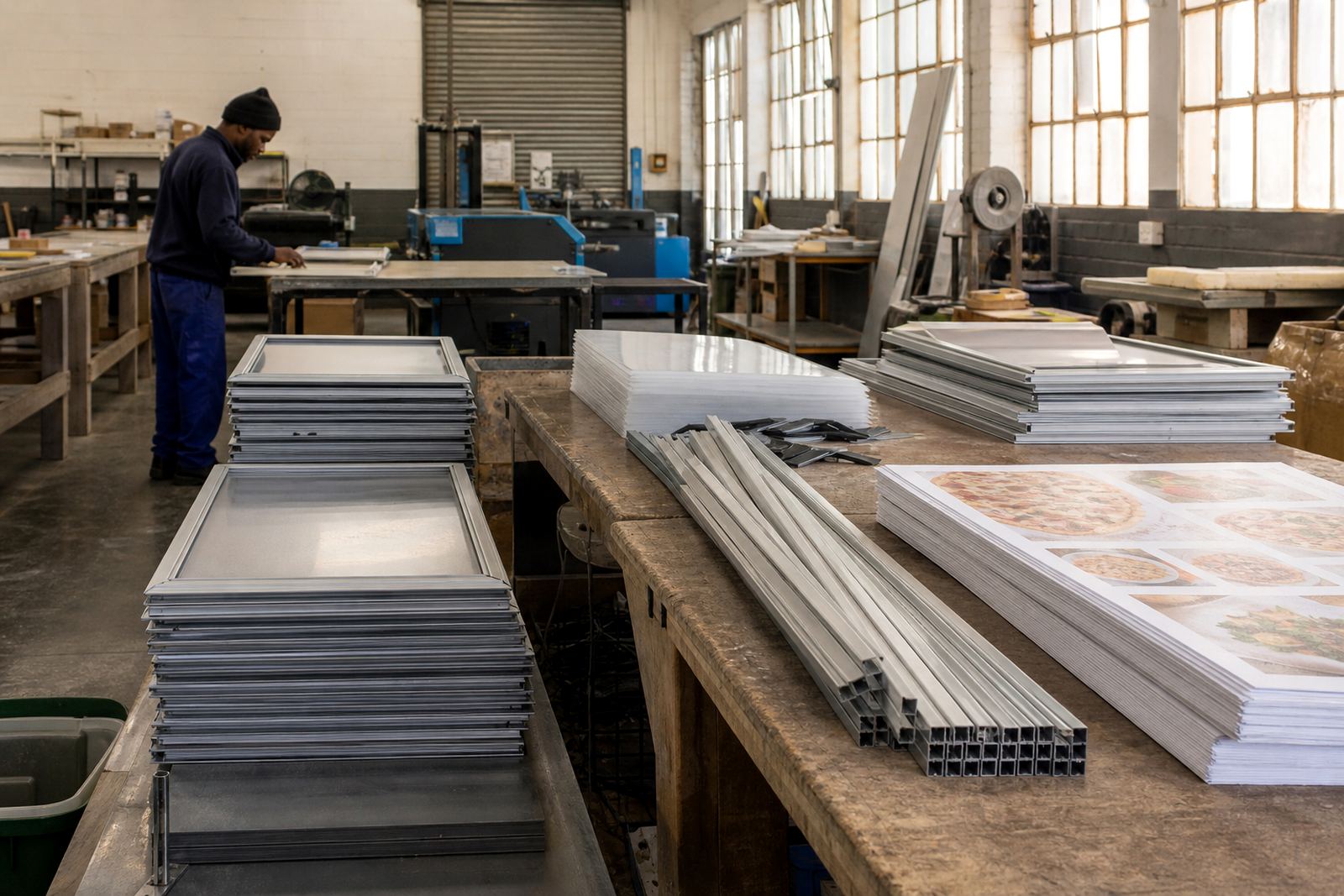
That early practical approach still runs through the business now. We work with A4 and A3 snap frames, wall and window mounting, A-frame stands, chalkboards and printed menu inserts. The aim is not decorative clutter. It is a neat menu system that holds up in a busy service area and keeps the message clear for customers standing at the counter.
What the early trade taught us
Working in food service exposed the small things that matter. Steam from a kitchen, fingerprints on glass, strong sunlight through a front window, and constant handling around a payment point all affect how a menu looks by the end of service. Those conditions pushed the team to think carefully about aluminium profiles, anti-glare covers and finishes that stay readable.
That habit carried into how we handle print and framing today. Menu sizes have to match the board, artwork has to sit cleanly, and the insert should lift out without fuss. A menu board that looks fine on a sample table can still fail on a real wall if the proportions are off, so the work stays practical from the start.
- A4 and A3 snap frame sizes for compact or larger menu displays
- Anti-glare covers that help with bright interiors and window light
- Wall, window and counter-facing mounting options
- Short run printing for specials, seasonal changes and test menus
The customers who shaped the range
Our customer base grew with the food trade around us. Restaurants wanted a cleaner way to show lunch boards. Cafes needed menu inserts that could be updated without sending every small change back through a print cycle. Bars asked for boards that could carry drinks lists, tasting notes and specials without looking crowded. Takeaway counters needed durable, easy-to-read displays that could handle constant use.
That mix of clients pushed the range beyond one type of frame. Some spaces need a wall-mounted board at eye level. Others need an A-frame stand placed near the entrance or pavement edge. In some shops, a laminated menu print is the right fit. In others, a chalkboard panel gives staff a quick way to change wording during a rush.
- Restaurants that rotate lunch, dinner and set menus
- Cafes with compact counters and window-facing display space
- Bars that update drinks lists and specials often
- Takeaway counters that need clear, hard-wearing signage
How the team works with the job in front of them
The present-day team is built around different parts of the same task. One person handles production detail, another checks artwork flow, another looks after sales queries, and another keeps installations and finishing on track. That structure matters because a menu board is only useful when the print, frame and mounting method all fit the site.
Marius Mlambo leads the business as Managing Director. Anele Zondo manages production. Bianca Ebrahim handles sales. Thabo Kajee leads installations. Liam Mkhabela coordinates print. Zanele Wessels handles customer support. Together they keep the work close to the realities of shop floors, counters, windows and walls across busy town centres and coastal areas where humidity can affect certain finishes.
- Menu typesetting and layout checks for readable spacing
- Menu proofing before printing starts
- Print finishing for clean edges and sharp presentation
- Courier packaging for boards and inserts travelling nationwide
Printed inserts, frames and boards in one line of work
The business did not stay limited to one product. It moved into menu resizing, laminated menu prints, poster insert printing and colour matching because the frame alone is not enough. A restaurant can have a strong board, but if the print size is wrong, the result feels awkward. The whole job has to work together.
That is why print-ready templates matter so much. A4 menu templates suit smaller boards and tighter counter areas, while A3 templates make sense where the menu needs more breathing room. Short run printing also helps when a venue is testing a seasonal list or adding one promotion to a counter display. The work stays grounded in actual use, not just a sample sheet on a table.
Paarden Eiland as the working base
Paarden Eiland gives the business a working base close to Cape Town's trade routes and distribution points. From there, orders move to Cape Town, Stellenbosch, Johannesburg, Durban, Gqeberha, Milnerton, Bellville and Paarl through courier delivery. That reach suits the kind of work we do, because a menu board is often needed at a branch or site far from the main office.
The area also suits the hands-on side of the trade. Frames, boards and printed inserts need careful packaging, especially when they are travelling to inland branches or coastal venues where conditions are different. A board leaving the shop in Cape Town may be headed to a cafe in Stellenbosch, a counter in Durban, or a takeaway site in Gqeberha, so the packing has to respect the journey.
Customers reach us through our enquiry form on our contact page when they need a new board, a menu update, or a print run that matches their current format. The process stays centred on practical details: size, mounting, print type and the finish that suits the site.