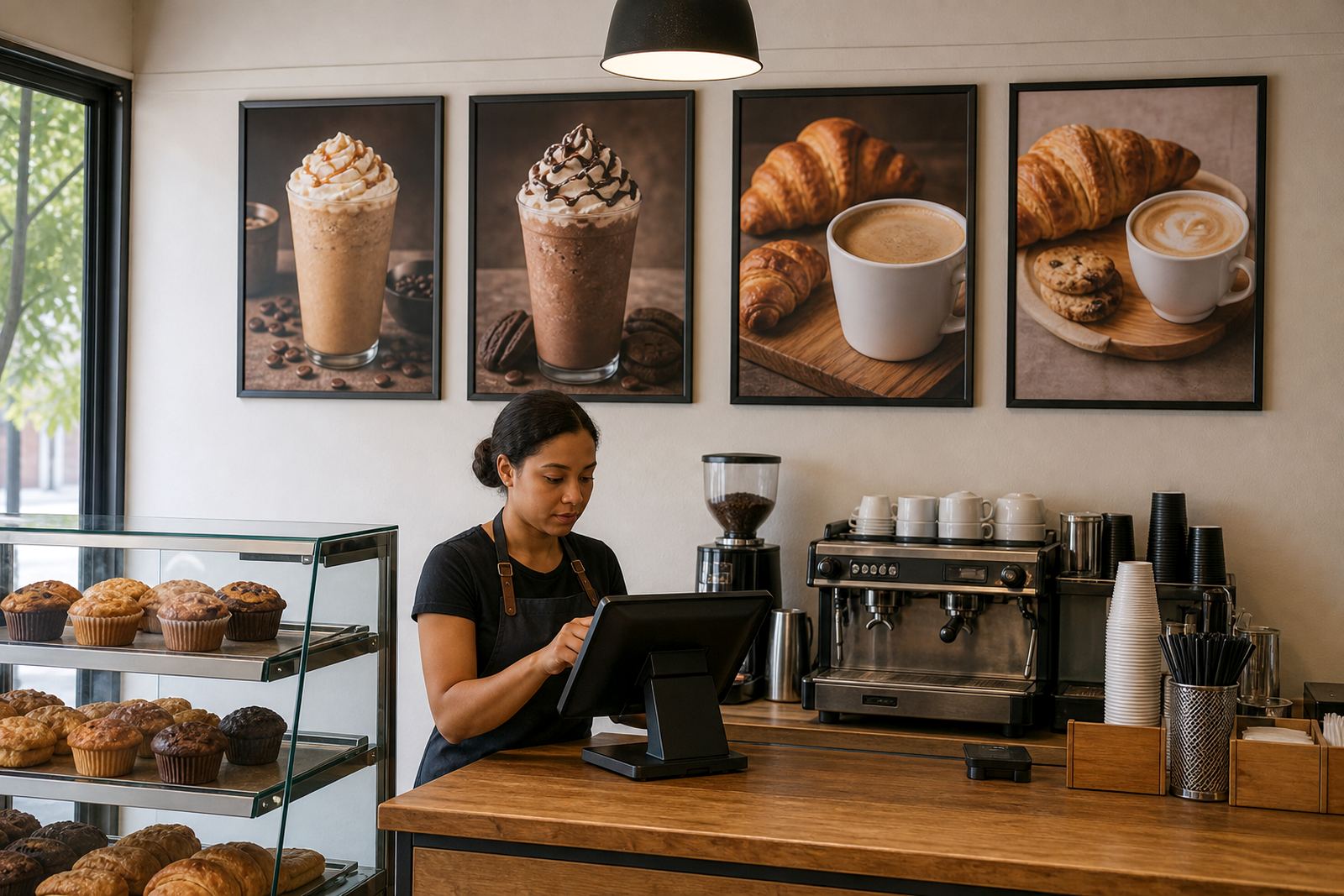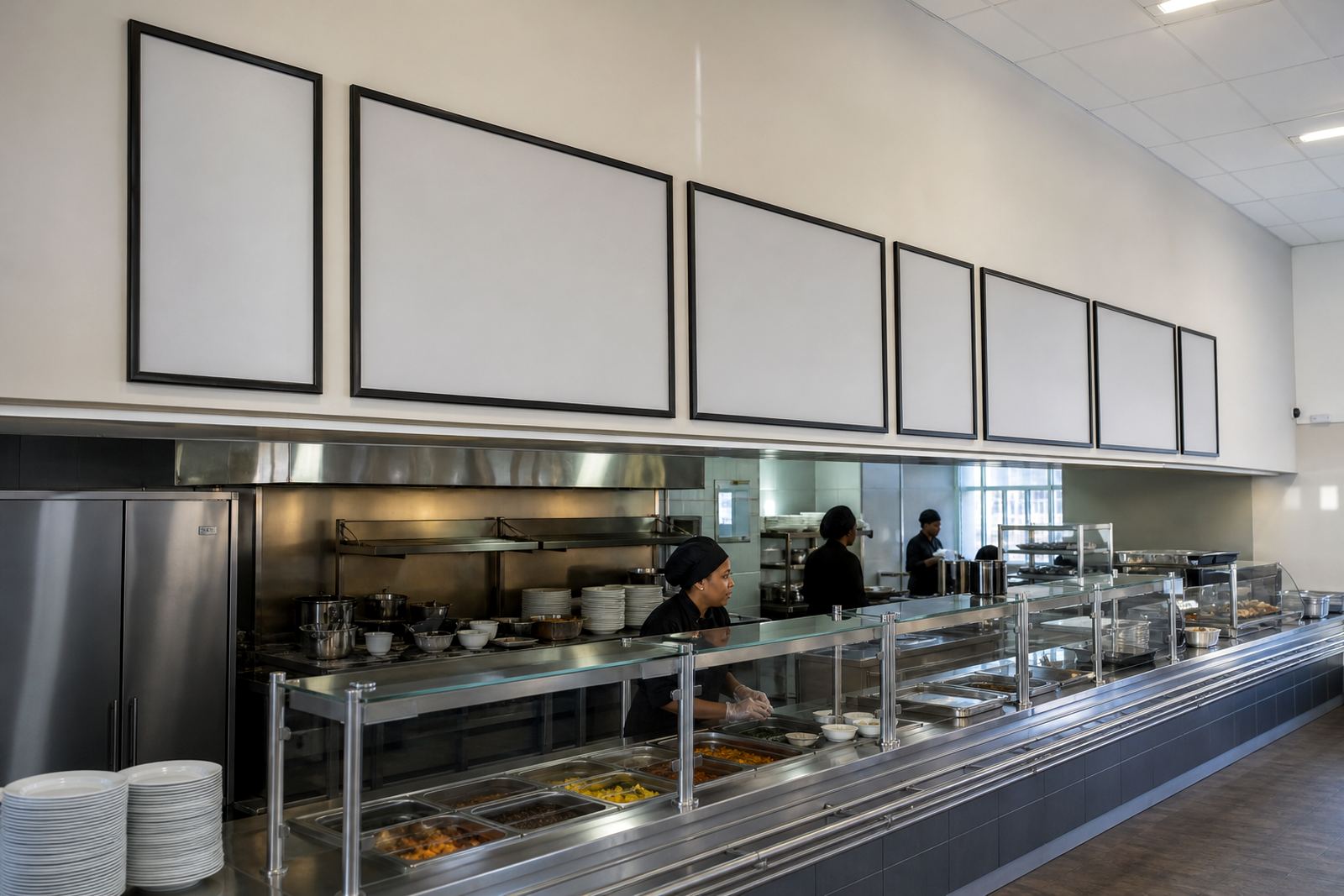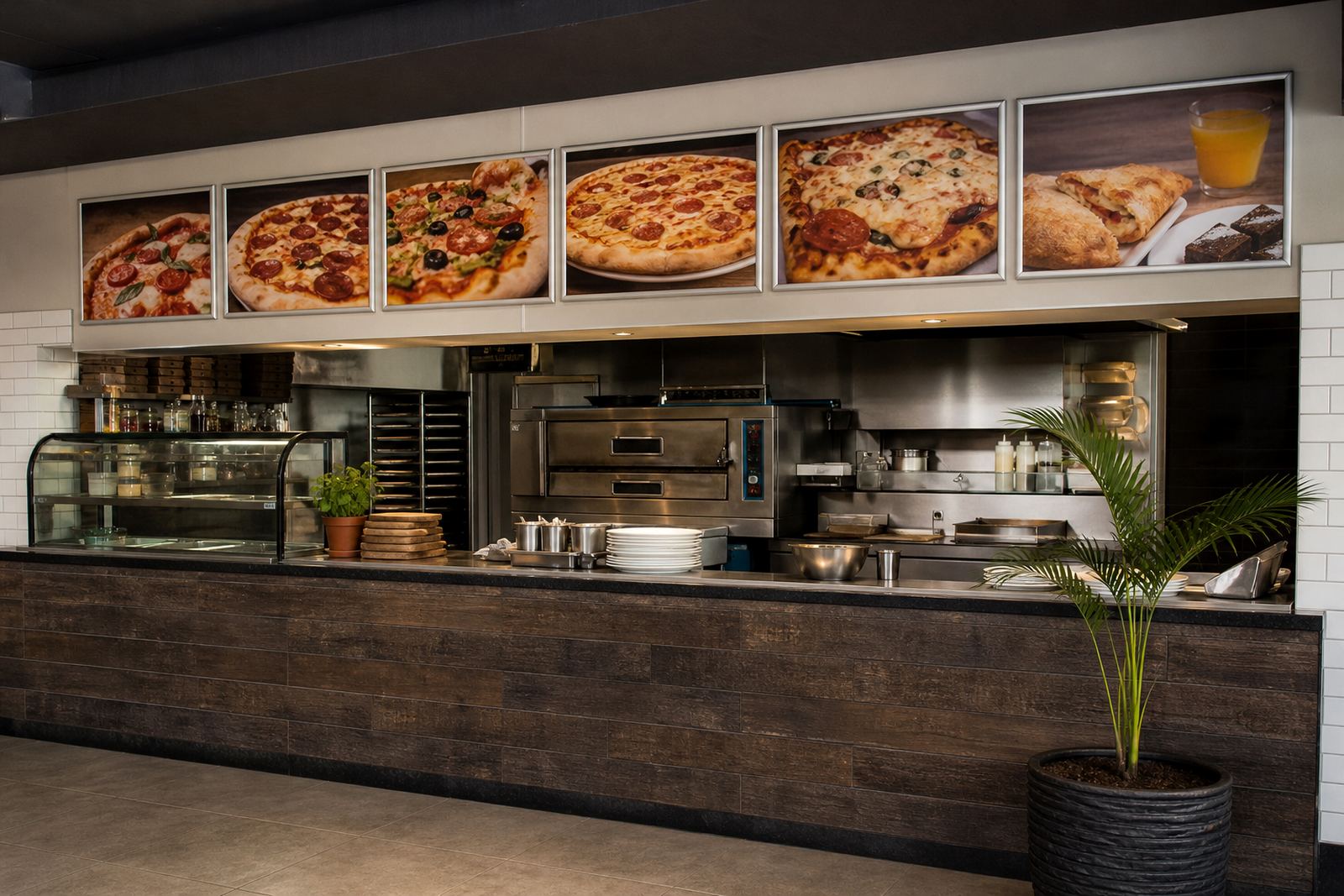
A cafe counter needs room for quick menu swaps
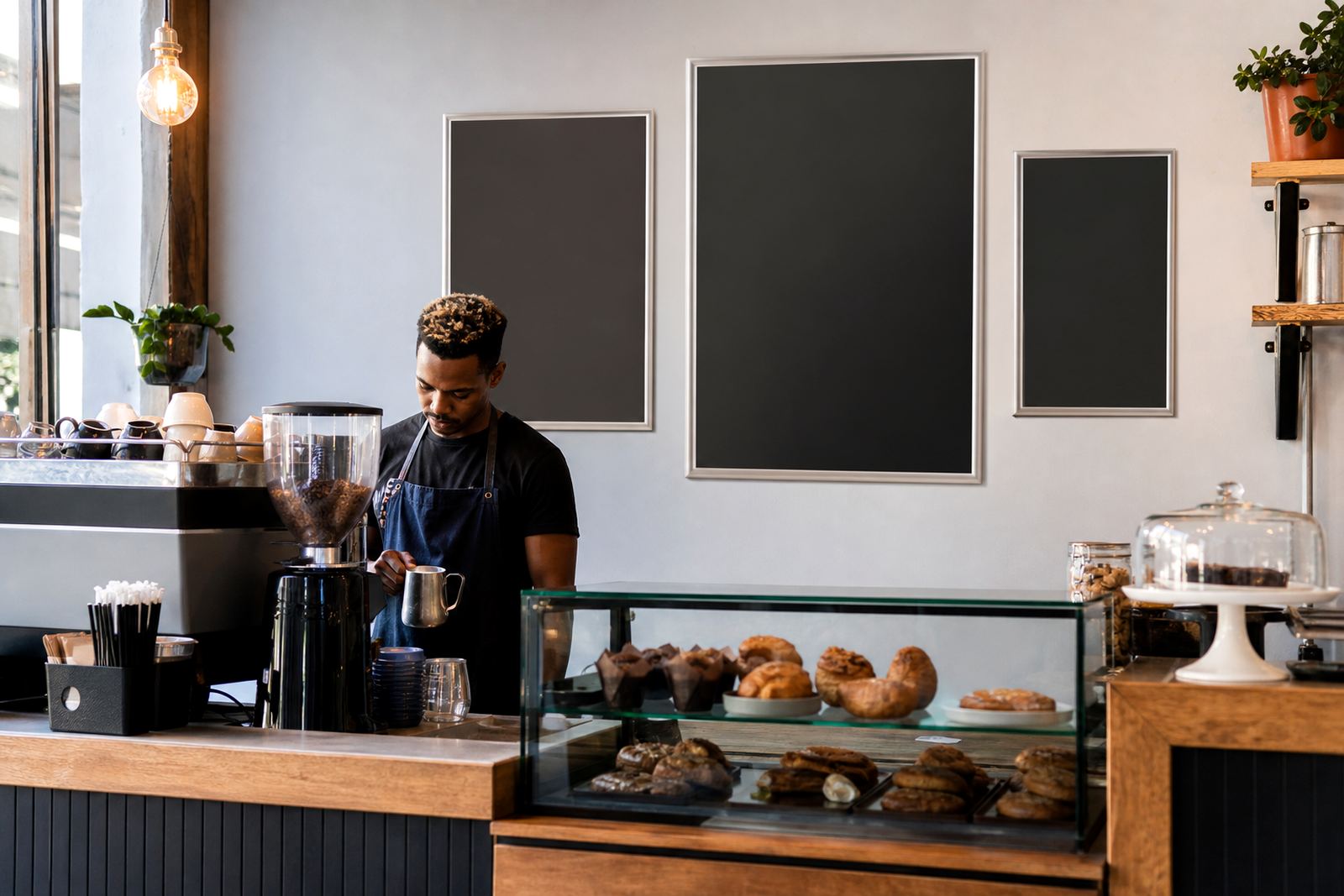
A cafe menu is rarely a single sheet that stays put. One board may carry breakfast wraps in the morning, another may switch to toasties, salads and cake slices by midday, then the drinks board needs a fresh list for iced coffee, tea and cold press options. In a busy cafe, the display has to keep up without forcing the team to reprint or rehang everything each time the menu shifts.
That is where snap menu frames and wall boards fit in well. The aluminium profile clamps the print under a clear front cover, so a staff member can open the frame, slide in a new insert and close it again. For cafes that change specials often, the point is not decoration alone, it is a display that stays straight on the wall and legible near the till, the pastry case or the takeaway window.
- A4 frames suit short specials, drinks lists and add-on boards.
- A3 frames carry fuller menus with enough room for item names and prices.
- Anti-glare covers help under bright shop lights and window reflections.
Boards that work around tables, windows and the till
The right set-up depends on where customers first read the menu. A wall-mounted board near the counter works well for dine-in ordering, while a window-mounted frame can carry trade on the street side for passers-by. A-frame menu stands are useful where the queue moves, because the board can sit close to the entrance without taking over the floor.
For cafes with handwritten specials, chalkboards have their place too. They suit daily soup, quiche, muffin or cake notes, especially when the offer changes after the morning rush. A chalkboard is not the same as a snap frame, though. Chalkboards handle loose wording and quick sketches, while snap frames keep printed menus neat and consistent. Many cafes use both, one for the stable menu and another for the items that shift through the day.
- Wall mounting suits fixed menus and compact counters.
- Window mounting suits takeaway traffic and street-facing service.
- A-frame stands are useful for pavement visibility and queue direction.
Sizing the menu so the page does not fight the space
A4 and A3 are the most common menu sizes for cafes because they match standard print layouts and keep the wording under control. An A4 menu is easier to read at close range and suits smaller drinks lists or short food boards. An A3 insert gives more breathing room for item groupings, price columns and a few more product lines without crowding the page.
Menu resizing matters when old artwork has been built in the wrong proportion. A narrow breakfast sheet can look lost inside a larger frame, while a crowded A3 page may push prices into the edges and make the board hard to read from the till. We also look at orientation, portrait for narrow lists and landscape where a cafe menu needs wider columns. If the menu is going into a frame near a window, the layout should allow for light reflection and viewing distance as well.
- Use portrait for narrow lists and simple price blocks.
- Use landscape for breakfast boards with several categories.
- Leave enough margin so no text sits too close to the edge.
Print finishing that survives fingerprints and steam
Cafes deal with fingerprints, humidity from coffee machines and the occasional splash near the counter. A laminated menu print helps protect the sheet and keeps the colours sharper for longer. Anti-glare covers are useful on frames close to bright lights or glass doors, because shiny reflections can make a menu difficult to read from an angle.
For printed inserts, colour matching and proofing help the menu stay consistent across reprints. A pale cream background can shift badly if the printer lays down too much ink, and dark type can lose clarity if the contrast is off. If the cafe needs posters for specials, poster insert printing can be used inside a larger frame, while short run printing helps with seasonal menus or a short test batch before a full update.
- Laminated inserts handle regular wiping better than plain paper.
- Proofing helps catch spacing, spelling and price layout problems.
- Courier packaging matters when the menu boards travel nationwide.
Common cafe mistakes that make menus harder to read
The most common mistake is overfilling the board. Too many items, too many price points and too much mixed wording can turn a simple menu into a wall of noise. Another problem is using one layout for every surface, even when the board size changes between A4 and A3. The result is often tiny text in a big frame, or a sheet that looks cramped and rushed.
Low contrast is another issue. Grey text on a pale background, or thin lettering placed under a glossy cover, can be hard to read from the queue. Some cafes also place the menu too high or too low, so customers lean or squint while trying to order. A better approach is to keep the main items near eye level, reserve chalkboards for specials and update the pricing without crowding the design. Small slips in layout cost more time than people expect, especially when the board is handled daily.
- Avoid mixing too many fonts on one menu.
- Keep pricing aligned in a clean column.
- Do not place critical text where glare will catch it.
Budget ranges in Rand for cafe menu set-ups
Cafe menu budgets depend on the number of boards, the size of the inserts and whether the set-up needs wall mounting, window mounting or an A-frame stand. A basic A4 snap frame with a printed insert is usually the lowest entry point. Larger A3 units, multiple boards and finishing work move the budget up, especially where several menu categories need their own frame.
For planning, many cafe owners start with a small set of boards and build from there. A simple front counter set-up may use one drinks board, one food board and one specials board. A larger cafe may want separate frames for breakfast, lunch, dessert and takeaway service. Courier delivery across South Africa adds a packaging and transport element, but it is often simpler than trying to move boards in a vehicle that is already full of stock. As a rough working range, small cafe menu jobs can begin around a few hundred Rand per board, while larger framed sets with printing and finishing can move into the low thousands depending on quantity and format.
- Single frames suit small counters and one-page menus.
- Full sets suit cafes with separate food and drinks lists.
- Printed inserts and finishing add value when menus change often.